
Last reviewed: August 20, 2026
Is Online Gambling Legal in India?
Online real-money gambling (casino, poker, rummy, fantasy, sports betting) is banned nationwide under the Online Gaming Act 2025 / Rules 2026. Land-based casinos in Goa, Sikkim, and Daman are legal. State lotteries are legal where permitted (such as West Bengal’s Dear Lottery). Betting on horse racing is legal (skill argument). Esports and non-money social/casual games (e.g. video games or mobile games) are permitted.
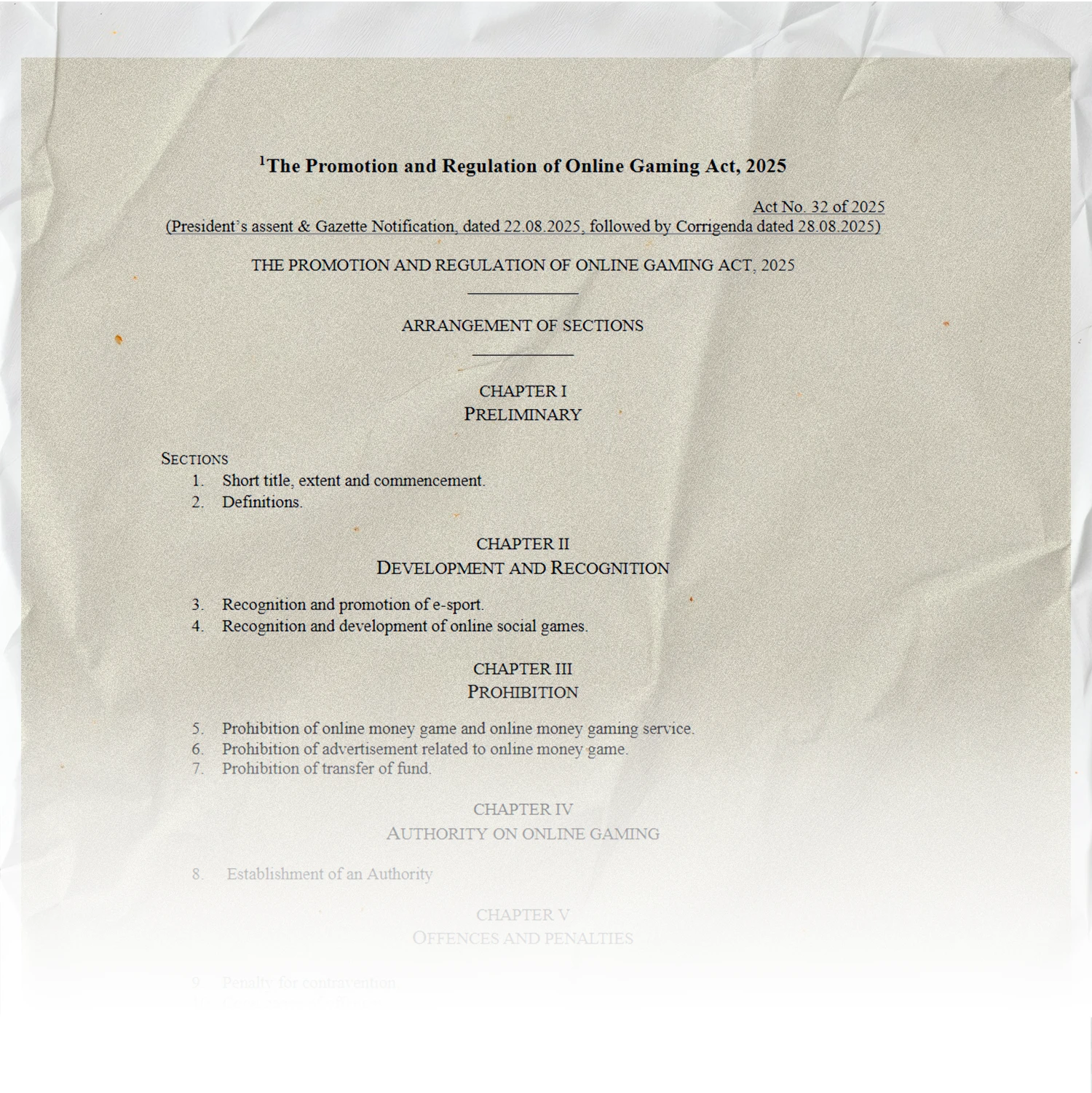
India passed the Promotion and Regulation of Online Gaming Act, 2025, which bans online real-money games. As the 9-page act (PDF) outlines, advertisements related to online money games or payments for any online money gaming service are also prohibited. In August of 2025, the PROG Act was introduced, passed in Lok Sabha, and passed in Rajya Sabha within 2 days. After roughly a year of the Act, the Ministry of Electronics and Information Technology (MeitY) put into force the Promotion and Regulation of Online Gaming Rules, 2026.
Simply put, the PROG Act (August 2025) is the actual bill, and the PROG Rules (April 2026) are the set of regulations that enforce and operationalise the Act. These rules came into force on May 1, 2026. You can read the official notification in The Gazette of India (PDF).
What Does the Latest Act Ban?
The law imposes a nationwide ban on all “online money games,” whether skill-based or chance-based. An online money game is any game where the player makes a payment, and the main expectation is winning money or other rewards, not entertainment. Their advertising and processing or related payments by banks are also prohibited. This kills the old “game of skill” carve-out that online rummy, poker, and fantasy sports (Dream11, etc.) relied on.
Land-based casinos in Goa, Sikkim, and Daman remain legal under state law because the Act is online-only. The law targets operators, facilitators, advertisers, and payment processors, not individual players. But currently, this is untested.
What the 2025 Online Gaming Act Did
The Act was assented to on August 22, 2025. The PROG Rules were effective on May 1, 2026. Together, they make up the current law on online gambling in India. Everything is in force; nothing is pending. This law puts a blanket ban on all online money games, covering both skill- and chance-based ones. So, there’s no more “skill” argument shielding real-money play online.
Esports, online social/casual games, non-money games, etc. are still allowed. Though the law doesn’t specifically reference “video games” anywhere, it’s reasonable to assume that between esports and online social or casual games, all online video games are already covered and not prohibited, even if players can spend money on them.
Banks and payment gateways have been barred from processing money-game transactions.
Needless to say, the current law is highly restrictive. Operators have not taken well to this and have mounted multiple lawsuits, challenging the Supreme Court across aspects. The SC collapsed the stakes reality as well (uncertain financial stake changes any economic activity to gambling). Furthermore, a different SC bench ruled that online real-money activities constitute “betting and gambling” under the GST framework, and will retrospectively accrue a 28% tax. The SC agrees to hear pleas challenging the new law. An analysis in the Supreme Court Observer is a good read for the complete picture.
Here is a breakdown of what is legal, what is illegal, and the gray areas:
| Type of Gambling | Legality Status |
|---|---|
| Online casinos (real money) | Illegal (nationwide, Act 2025) |
| Online poker and rummy (real money) | Illegal now (previously legal as “skill-based,” overridden) |
| Online sports betting and fantasy (real money) | Illegal now |
| Land-based casinos | Legal only in Goa, Sikkim, and Daman and Diu (state-licensed) |
| State lotteries | Legal where the state permits or runs them, varies |
| Horse race betting | Legal (treated as skill), at licensed racecourses and via authorised channels |
| E-sports and social (non-money) | Legal, registrable with OGAI |
| Crypto & offshore gambling | Illegal/unlicensed and risky |
Regulatory Bodies & Governing Laws
A quick summary of the laws and governing bodies pertaining to online gambling in India, ignoring all older acts and laws which are no longer working. Click on the name of the Act or Bill to read it.
| Act/Body | Scope | Description |
|---|---|---|
| Online Gaming Authority of India (OGAI) | National body | Attached office under the MeitY. Registers esports/social games and enforces the ban. |
| The Promotion and Regulation of Online Gaming Act, 2025 | National | The Act that prohibits online real-money games. |
| Promotion and Regulation of Online Gaming Rules, 2026 | National | The set of rules and regulations that enforce the PROG Act. |
| The Goa, Daman, and Diu Public Gambling Act, 1976 | Territories of Goa and Daman and Diu | Bans unauthorised gambling establishments and gambling activity, while creating specific exceptions for games of skill and Government-authorised casino gaming. |
| The Sikkim Casino Games Bill, 2022 | Sikkim | The 2022 amendment changes how casinos are charged in Sikkim: it replaces the existing Section 7 with an annual casino licence fee determined by the State Government. |
| The Telangana Gaming Act, 1974 | Telangana | It prohibits both physical and online money/stakes gaming, and its definition of wagering is broad enough to cover betting on games of skill. |
| Andhra Pradesh (Telangana Area) Gambling Act, 1305 F | Andhra Pradesh | A traditional anti-gambling law targeting gambling houses, public gambling and betting activity. It does not apply to games of mere skill. |
| West Bengal Gambling and Prize Competitions Act, 1957 | West Bengal | An anti-gambling law that also regulates prize competitions, with unusually explicit exclusions for certain card games and a licensing framework for horse racing and smaller prize competitions. |
Note that “gambling” and “betting” remain to be a State subject (Entry 34, List II), but the Centre legislating online money gaming under Union powers is the main basis for our context. States can still allow land-based casinos and government-run lotteries, for example. Goa has offshore vessels as well as onshore establishments. Sikkim and Daman both have establishments.
Also, several states had already banned online money gambling even before the nationwide 2025 Act. These include Tamil Nadu, Karnataka, Telangana, and Andhra Pradesh. A 2026 Supreme Court upheld these (for example, in State of Tamil Nadu v Junglee Games India, the SC held that “betting on games of skill amounts to gambling and is not protected under Article 19(1)(g)).
And in some cases, older laws in states like Sikkim and Nagaland have been overridden by the new national Act. How states evolve their own enforcement on top of the Central Act remains to be seen.
Players vs. Operators
At Casino Atlas, it is our job to make sure you fully understand precisely how gambling is prohibited and managed in India. The problem is that the law is in a nascent stage right now and the market is very volatile. How states will build enforcement on top of the Act, how operators will challenge the court, etc., are a couple of the many variables that we must keep an eye on. Meanwhile, here is what you should know:
- The Indian law penalises operators up to 3 years and a fine of ₹1 crore; repeat offenders can be fined for up to 5 years with up to ₹2 crore in fines.
- Payment processors and banks that facilitate payments to/from these online gambling service providers are also penalised.
- The law does not expressly criminalise individual players. At least, nothing suggests the same in the Act’s operative offences. But this is legally untested at the time of writing.
- There is a very real fund withdrawal risk as well as KYC and tax exposure with no legal recourse. There is no criminal prosecution risk as per the current information.
- Offshore, unlicensed, or crypto-only sites without a base in India will still work in India. But there is no legal recourse. Your funds are still at risk (as you will use Indian payment methods). Offshore betting is clearly on the rise, but you never know how and when strict enforcement will begin. It is a gamble.
- Using VPNs and non-Indian payment methods like e-wallets or crypto still run you the risk of violating Terms. Circumventing bans is never recommended.
- Winnings are subject to taxation and TDS, including the value you liquidate through cryptocurrency exchanges.
We queried 50+ Indian players who regularly deposit on sports betting sites with a clear India-facing brand and observed their usage. Here is what we found: These casinos give you personal UPI IDs. One day when you deposit, you might be transferring your funds to Mr. X and another day, it might be Ms. Y. They match the reference IDs to top up your wallet. This allows these brands to still offer their services. If a UPI ID gets blocked by the bank/government, they will simply supply you with a new one. But the real risk is this: if you are regularly making deposits to random UPI IDs belonging to people who keep getting blocked, this can be seen as a pattern. This pattern can be used to enforce the law against you. No examples exist to prove this claim, but we must notify you of this very real danger. Many players have experienced frozen funds or disabled accounts/methods even before the 2025 Act.
Getting Help
The best way to learn more is to go over our Responsible Gambling page. You will find a list of resources such as gambling helplines and blocking software that can help you get away from gambling in a systematic manner. India does not have a single national gambling self-exclusion registry the way other markets (such as Australia and the UK) do.
Our honest take? Despite a huge section of the population gambling actively, India has nothing else apart from the government-mandated MANAS program with its helpline. Several organizations offer programs for help with problem gambling, but they are all paid, and it’s not clear just how reliable they are anyway. You must rely on global tools.
Tele MANAS: 14416 or 1-800 891 4416, toll-free number to get in touch with a counselor.
The Promotion and Regulation of Online Gaming Act 2025 prohibits real-money online gaming in India and the advertising of it, including affiliate links. Casino Atlas does not promote real-money play to users in India.
All information on this page is for educational purposes only and does not constitute legal advice. Laws change over time, and the case of Indian gambling regulation is very new right now, with many volatile factors. We do not claim to have the most accurate picture on this page at all times. Always verify everything with official sources or qualified professionals. Nothing here is definitive counsel.
Historical Timeline
-
The Public Gambling Act, 1867 Prohibits all forms of gambling nationwide but explicitly gives power to states to regulate or legalise gambling activities within their territories.
-
The Goa, Daman and Diu Public Gambling Act, 1976 Gambling became legal in Goa and Daman and Diu.
-
The Information Technology Act 2000 (IT Act) Surprisingly, this crucial act does not mention “gambling” at all, thus offering no clarity on online gambling.
-
Telangana & Andhra Pradesh These two states have passed explicit legislation banning all forms of online gambling, effectively outlawing it entirely within their territories. Any form of real-money gambling has long been banned in these states.
-
Maharashtra Maharashtra originally passed a casino act permitting casinos, but enforcement has remained limited. Recently, the state also passed laws explicitly prohibiting online gambling activities, yet enforcement has been lax and largely ineffective.
-
Rummy Rummy was exempted for the most part, being placed in the category of a “game of skill.” That has been overturned by the 2025 Act.
-
2025 PROG Act is passed. It prohibits all real-money gambling.
-
2026 PROG Rules are enforced, putting the Act’s powers in action.
-
SC Challenge Gambling operators plan to move the Supreme Court, challenging it for the 28% GST as well as the blanket ban on all forms of real-money gambling.