
Last reviewed: August 21, 2026
Is Online Gambling Legal in Canada?
Yes, when a provincial government runs/licenses it. The federal law lets provinces conduct and manage gambling, so the legal options depend entirely on where you live. In Ontario and Alberta, there is an open, competitive gambling market with many private, licensed operators. Elsewhere, government platforms like PlayNow, Espacejeux/Mise-o-jeu+, Atlantic Lottery, etc., are legal.
On top of that, offshore casino sites are accessible across Canada and not a crime to use, but they are not provincially licensed and carry no consumer protection. This is the Canadian online gambling “gray market.”
As for sports betting, single-event betting has been legal nationwide since August 2021 (Bill C-218), which is delivered through each province’s own channels.
The minimum age for gambling is 18 in Alberta, Manitoba, and Quebec. It is 19 in every other province and territory (for casino and online play).
Current Canadian Gambling Law: Simple Version
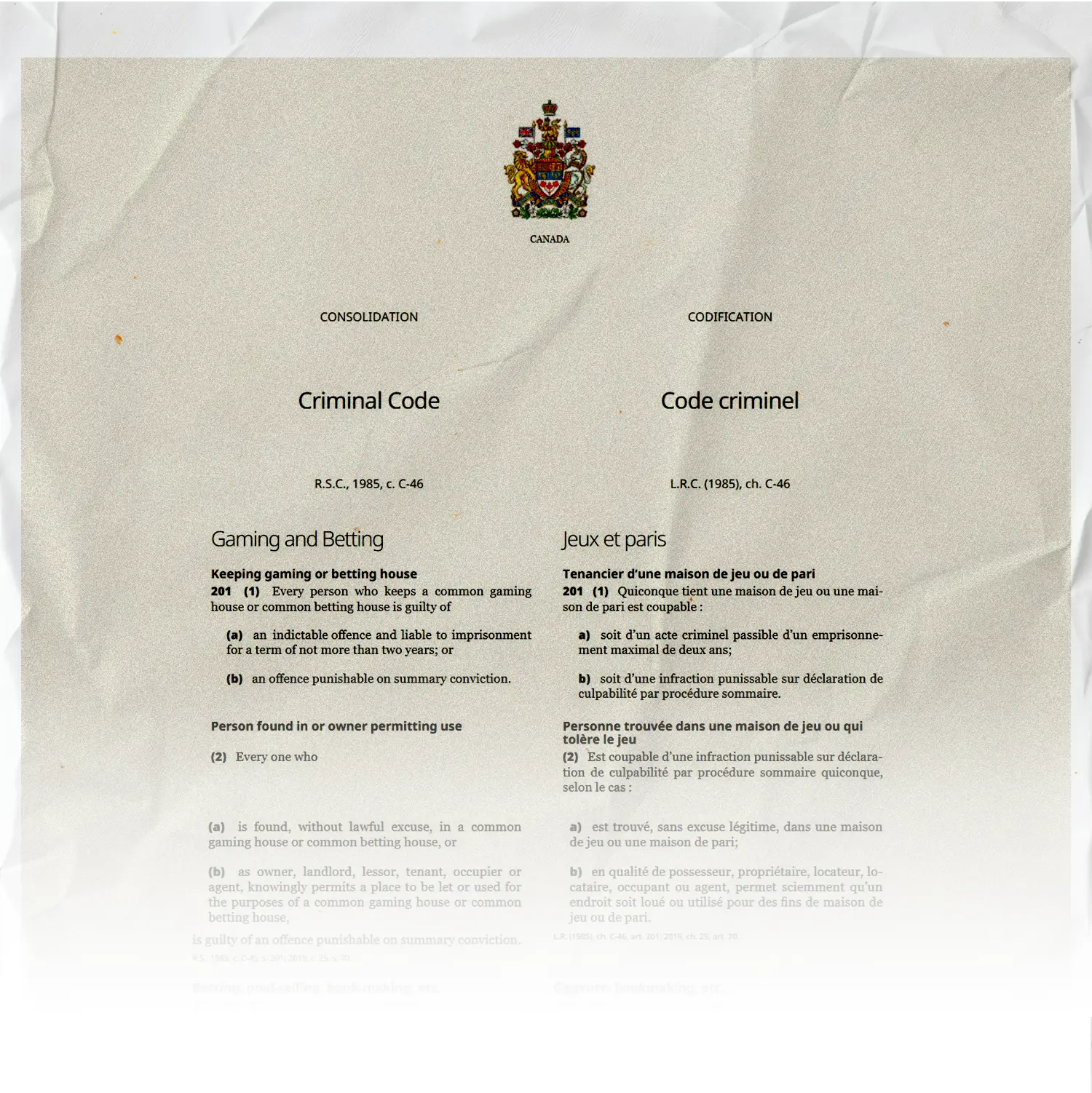
Gambling is governed federally by the Criminal Code of Canada (Part VII, sections 201 to 207). The Code prohibits gambling by default. But Section 207 makes it lawful when a provincial government “conducts and manages” a “lottery scheme.” That term is loose enough to cover casino games, poker, slots, and betting.
Each province either runs a gambling platform itself or licenses private operators to run it under provincial oversight. There is no national online gambling license and no single national regulator.
Single-event sports betting became legal nationwide through Bill C-218, the Safe and Regulated Sports Betting Act. It received Royal Assent on June 29, 2021 and came into force on August 27, 2021 (Canada Gazette). Before that, Canadians could only bet parlays of three or more events through provincial lottery products such as PRO-LINE or Sport Select, which pushed enormous demand offshore.
As delivery is provincial, the same activity can be a fully licensed local market in one province and a government monopoly next door. For Canadians, the real question is not if gambling is legal but if it is legal where they live.
Three Provincial Models: What is “Legal” Gambling in Canada
There are three main models of how “legal” gambling works in Canada:
- Open Competitive Markets
Multiple private operators compete under provincial oversight. This exists in Ontario (since April 4, 2022) and Alberta (since July 13, 2026). In both, a government entity “conducts and manages” the market and signs agreements with private operators. - Government Monopoly
One provincial platform is the only fully licensed option. Examples include PlayNow (British Columbia, Manitoba, Saskatchewan), Espacejeux / Mise-o-jeu+ (Quebec, via Loto-Québec), and Atlantic Lottery/Proline (Nova Scotia, New Brunswick, Newfoundland and Labrador, PEI). - Territories
Yukon, Northwest Territories, and Nunavut have no provincial online gambling platform. Residents can use retail Sport Select and otherwise turn to offshore sites, which are not territorially regulated.
Of course, as with any other place, Canada also has a fourth model: the offshore gray market.
Provinces are opening these markets specifically to reclaim revenue and add protections. In Alberta, the government estimated roughly 70% of online gambling was happening on unregulated offshore sites before its launch as per Alberta iGaming Strategy.
Canadians often misunderstand this. Offshore sites (sites licensed abroad or by the Kahnawà:ke Gaming Commission, but not by your province) are accessible everywhere and not a crime for you to use. They are simply outside your province’s regulated system. When playing on them, you give up provincial consumer protections, enforceable dispute resolution, and any guarantee on payouts. If something goes wrong, you have no provincial regulator to complain to. Check your province’s public register. If a brand is not on it, it is offshore. Here is the database of all Ontario-licensed operators, and here are all the Alberta-registered iGaming sites.
Here is a breakdown of what is legal, illegal, and still gray:
| Category | Status | Note |
|---|---|---|
| Online casino (playing, as an individual) | Legal | Not a crime for the player anywhere in Canada. Where it is licensed depends on your province. |
| Online casino (provincially licensed operator) | Legal | Fully licensed in Ontario and Alberta (open markets) and via the single government platform elsewhere. |
| Online casino (offshore or not provincially licensed) | Gray area | Accessible nationwide, legal for the player to use, but unlicensed locally and outside Canadian consumer protection. |
| Online sports betting (single-event) | Legal | Nationwide since Aug 27, 2021 (Bill C-218), delivered through each province’s channels. |
| Online poker | Legal | Treated as a lottery scheme. Offered on licensed provincial platforms. Also common offshore (gray). |
| Land-based casinos | Legal | Operated or licensed by each province and widely available. |
| Lotteries | Legal | Run by provincial and interprovincial lottery corporations. |
| Horse racing (pari-mutuel) | Legal | Federally overseen by the Canadian Pari-Mutuel Agency, in addition to provincial rules. |
| Crypto gambling | No special status | Not separately legalized or banned. Provincial sites generally do not support crypto; offshore crypto casinos sit in the same gray area. |
Regulatory Bodies & Governing Laws
Click any Act to read it in full on the official New Zealand Legislation website.
| Act/Body | Scope | Description |
|---|---|---|
| Criminal Code of Canada (ss. 201-207) | Federal | Prohibits gambling by default; section 207 lets provinces “conduct and manage” it. The foundation of the whole system. |
| Bill C-218, Safe and Regulated Sports Betting Act (2021) | Federal | Legalized single-event sports betting nationwide (in force Aug 27, 2021). |
| Alcohol and Gaming Commission of Ontario (AGCO) | Ontario | Regulates Ontario’s gambling sectors, including the open iGaming market. |
| iGaming Ontario (iGO) | Ontario | The provincial entity that “conducts and manages” the market and contracts private operators. Publishes the register of licensed operators. |
| Alberta iGaming Strategy / AGLC | Alberta | AGLC regulates; the new Alberta iGaming Corporation (AiGC) conducts and manages the open market launched July 13, 2026 (iGaming Alberta Act / Bill 48). |
| British Columbia Lottery Corporation (BCLC), PlayNow | BC, MB, SK | The government platform for British Columbia, and (via partnership) Manitoba and Saskatchewan. |
| Loto-Québec | Quebec | Runs Quebec’s monopoly platforms: Espacejeux (casino) and Mise-o-jeu+ (betting). Regulated by the Régie des alcools, des courses et des jeux. |
| Atlantic Lottery Corporation (ALC) | NS, NB, NL, PEI | The government platform (and Proline betting) for the four Atlantic provinces. |
| Ontario Lottery and Gaming Corporation (OLG) | Ontario | Runs Ontario’s land-based casinos, lottery, and the government OLG.ca site. |
| Kahnawà:ke Gaming Commission (KGC) | First Nations | A Mohawk-run regulator licensing online operators since 1999. Recognizable, but a KGC license is not a provincial license. |
| Canadian Pari-Mutuel Agency (CPMA) | Federal | Oversees pari-mutuel betting on horse racing. |
Regional Specifics to Keep in Mind
Use the information below to find the model and legality for your own province.
| Province/Territory | Model | Legal Online Platform(s) | Min. Online Age |
|---|---|---|---|
| Ontario | Open competitive | iGaming Ontario operators (80+ registered) plus OLG.ca | 19 |
| Alberta | Open competitive (from 13 Jul 2026) | Private operators plus PlayAlberta | 18 |
| British Columbia | Government monopoly | PlayNow (BCLC) | 19 |
| Manitoba | Government monopoly | PlayNow (via BCLC) | 18 |
| Saskatchewan | Government monopoly | PlayNow (Saskatchewan) | 19 |
| Quebec | Government monopoly | Espacejeux and Mise-o-jeu+ (Loto-Québec) | 18 |
| Nova Scotia, New Brunswick, Newfoundland & Labrador, PEI | Government monopoly | Atlantic Lottery / Proline (ALC) | 19 |
| Yukon, NWT, Nunavut | No online platform | Retail Sport Select only | 19 |
Ontario is Canada’s template. It is regulated by AGCO and conducted and managed by iGaming Ontario. It has 80+ licensed operators. In 2025, the market generated on the order of C$4 billion in gross gaming revenue on roughly C$98 billion in wagers (up about 34% year-over-year as per Gambling Insider). It is the most comparable Canadian market to New Jersey or Michigan.
Alberta is the newest. Launched on July 12, 2026 under the iGaming Alberta Act (Bill 48) [PDF], with AGLC as the regulator and the new Alberta iGaming Corporation (AiGC) managing operator agreements. Around two dozen operator sites went live on day one, with close to 50 registered, alongside the continuing government platform PlayAlberta. Alberta also built a centralized self-exclusion system that applies across all operators, which is a strong genuine consumer-protection step.
BC, Manitoba, and Saskatchewan are monopoly provinces. They share the PlayNow platform, while Quebec runs Loto-Québec’s Espacejeux and Mise-o-jeu+. The four Atlantic provinces use Atlantic Lottery. In each, the government site is the only fully licensed option. Offshore sites remain a gray alternative.
Territories have no online platform, so residents rely on retail options and offshore sites.
In Reference re iGaming Ontario (Ontario Court of Appeal, 2025), the court considered whether Ontario’s licensed online gaming stays lawful if Ontario players are pooled with players outside Canada (relevant to shared poker and jackpot liquidity). This is still an evolving story.
Players vs. Operators
The Criminal Code’s gambling offenses are aimed at operators and keepers who run or profit from unauthorized gambling, not at individual players. No Canadian has been prosecuted for playing on an offshore site, and commentators note Canadian courts may lack jurisdiction over a purely offshore operator that has no “connecting factors” to Canada such as CAD deposits or direct advertising, as explained by Lexology’s general introduction to gambling law in Canada (needs account).
Section 207 does technically contain a participation offense for taking part in an unauthorized lottery scheme, prosecutable on summary conviction. In practice, it is not used against individuals gambling on offshore sites, which is exactly why the offshore market is described as a “gray area” rather than “illegal for players.” Not prosecuted is not the same as a positive legal right.
For operators, running online gambling for Canadians without the right provincial authorization is the offense. That is why offshore brands are unlicensed rather than licensed, and why the provincial registers matter.
In Ontario and Alberta, the licensed and the offshore versions of the same brand may both exist. The licensed one is the one on the provincial register, subject to local rules and complaint channels. Everywhere else, the government platform is the licensed one.
The Kahnawà:ke Gaming Commission, run by the Mohawk Council of Kahnawà:ke near Montreal, has licensed online casinos since 1999, making it one of the oldest online-gambling regulators in the world. Its authority rests on asserted self-government under the Constitution Act, 1982. It has clashed with both Quebec and Ontario over their moves into online gaming, and in 2022 the Mohawk Council took Ontario’s iGaming launch to court (CBC). A KGC license is “Canadian-origin” but is not a provincial license, so a KGC-licensed site is still offshore/gray from your province’s point of view.
Quebec’s Bill 74 (2016) would have forced internet providers to block unlicensed gambling sites. In July 2018, the Superior Court of Québec struck it down as unconstitutional, ruling the province had intruded on federal jurisdiction over telecommunications. Even a province that wanted to block offshore play could not do it, and using offshore sites in Quebec remains legal for the player.
Alberta estimated ~70% of its online gambling was offshore before its July 2026 launch. Ontario’s regulated market has since grown to roughly CA$4 billion in annual gross gaming revenue. The direction of travel is clear: provinces are trying to pull players from offshore into licensed markets. This is a win-win. On an offshore site, you have no provincial regulator and no enforceable recourse. The strongest self-protection tools you actually control are your province’s self-exclusion program (if you use licensed sites) and a bank block on gambling transactions for offshore ones.
Do not use a VPN or any other way to circumvent the laws. The risks are clear: no legal recourse, frozen funds, and a breach of the operator’s terms of service.
Getting Help
There is no single national self-exclusion registry in Canada. Self-exclusion is run province by province, so a self-exclusion in one province does not automatically cover another. Here is what exists:
- Provincial self-exclusion programs tied to each licensed platform and land-based venues.
- Alberta’s new centralized self-exclusion, which applies across every licensed operator in the province (a step ahead of most others).
- GameSense (originated by BCLC) is a widely used responsible-gambling program adopted across several jurisdictions.
- The Responsible Gambling Council (RGC) is a long-standing national nonprofit focused on prevention.
Our Responsible Gambling page highlights the best practices for gambling safely and using tools to control your spend. Additionally, here are some resources specific to Canadian players:
Click on the URL below to open the website:
- camh.ca: Canada’s largest mental health teaching hospital with various support helplines and resources
- (Ontario) connexontario.ca: mental health, addiction, and problem gambling services via phone, webchat, and email
- (Ontario) betguard.ca: centralized self-exclusion tool for Ontario; anyone 19 or older can opt out of all regulated online gambling sites within Ontario
- (British Columbia) gamblingsupportbc.com: help for British Columbia residents having difficulties because of gambling
- (British Columbia) gamblingsupportline.ca: speak to a trained support specialist who will listen and connect you to the right next steps, including booking a session with a professional gambling counsellor
- (Saskatchewan) spgh.ca: call, chat, and email helpline for those experiencing problems related to gambling in Saskatchewan with confidential, professional advice free of charge
- (Manitoba) wellness.mb.bluecross.ca/counselling: part of the benefits plan of Blue Cross members, also open to the public; counseling for various mental issues available for Manitobans
- (Greater Toronto) ymcagta.org: YMCA Youth Gambling Awareness Program offers free educational, preventive programs
- (Ottawa) Mental Health Crisis Line: 613-722-6914, 1-866-996-0991 if outside Ottawa
- creditcanada.com: credit counseling and RG resources
- Alberta: 1-866-461-1259, 1-866-332-2322
- British Columbia: 1-888-795-6111
- Quebec: 1-800-461-0140, 1-866-767-5389, (514) 527-0140 (Greater Montreal)
- Manitoba: 1-800-463-1554
- Newfoundland: 1-888-899-4357
- New Brunswick: 1-800-461-1234
- Northwest Territories: 1-800-661-0844
- Nova Scotia: 1-888-429-8167, 1-888-347-8888
- Nunavut Kamatsiaqtut: 1-800-265-3333
- Ontario: 1-866-531-2600 (ConnexOntario), 1-888-230-3505
- Prince Edward Island: 1-855-255-4255, 1-888-299-8399
- Saskatchewan: 1-800-306-6789
- Yukon: 1-866-456-3838
Online gambling is regulated province by province. Casino Atlas lists casinos licensed offshore, not by your province. Check your local rules before you play. 19+ (18+ in Alberta, Manitoba, and Quebec).
All information on this page is for general educational purposes only and is not legal advice. Gambling law in Canada is set federally but delivered by each province and territory, and the rules, regulators, and licensed operators differ by location and change over time. We do our best to keep this page current, but we cannot guarantee it reflects the very latest position in your province at all times. Always verify anything that matters to you with official sources such as your provincial regulator or the Department of Justice, or with a qualified professional, before acting. Nothing here is definitive legal counsel.
Historical Timeline
-
1985 The Criminal Code is consolidated with section 207, cementing the rule that gambling is lawful only when a province conducts and manages it. This is the foundation of the modern system.
-
1996-1999 The Kahnawà:ke Gaming Commission is established and begins licensing online gambling, one of the first such regulators in the world.
-
2016-2018 Quebec’s Bill 74 attempts to force internet providers to block offshore gambling sites. The Superior Court of Québec strikes it down as unconstitutional.
-
April 4, 2022 Ontario launches Canada’s first open, competitive online market, regulated by AGCO and managed by iGaming Ontario.
-
August 27, 2021 Bill C-218 comes into force, legalizing single-event sports betting nationwide.
-
2025 Alberta passes the iGaming Alberta Act (Bill 48), setting up its own open market.
-
July 13, 2026 Alberta’s competitive market goes live, making it the second province with private licensed operators.
-
Ongoing Other provinces weigh whether to follow Ontario and Alberta, while the courts test how far provincial online markets can reach.